



















一、Software development company
The global software development services market is experiencing robust growth, with distinct dynamics shaping regional landscapes. North America leads with a dominant 50% market share, driven by tech innovation and enterprise digital transformation (Software Development Services Market Latest Size Report 2026). Europe follows closely with 25%, propelled by stringent security requirements and a focus on digital sovereignty (Software Development Services Market Latest Size Report 2026). Meanwhile, Southeast Asia is emerging as a key player, capturing 20% of the market through its cost-effective outsourcing models and rapidly expanding digital infrastructure (Software Development Services Market Latest Size Report 2026). These regions collectively contribute to the global market’s impressive projected growth from USD 289 Billion in 2025 to approximately USD 876.8 Billion by 2035 at a CAGR of 11.74% (Software Development Services Market Latest Size Report 2026).
1.1 北美:高价值与人才缺口并存
The North American software development services market, led by the United States, is characterized by high-value projects and a significant talent gap. The region’s market is projected to grow from its 2025 valuation, with key drivers including the adoption of AI, cloud-native development, and low-code platforms. According to Gartner and Statista data, these three technological pillars are fueling demand, with custom software development alone expected to grow at a CAGR of 22.6% (2026 Market Size, Developer Trends & Technology Adoption). This rapid growth is juxtaposed against a severe talent shortage, with over 1 million developer vacancies reported (Software Development Services Market Latest Size Report 2026). The scarcity of skilled professionals has driven up compensation, with experienced U.S. software developers earning a median salary of up to $210,000 annually (2026 Market Size, Developer Trends & Technology Adoption). This dynamic creates a unique challenge: while North America offers the highest value projects and technological innovation, the talent deficit necessitates strategic workforce solutions, including partnerships with specialized software development companies like Kextech Inc. that can provide access to global talent pools and expertise.
1.2 欧洲:合规驱动的稳健扩张
Europe’s software development services market is experiencing稳健扩张, primarily driven by regulatory compliance imperatives and a strategic focus on digital sovereignty. The EU’s General Data Protection Regulation (GDPR) has become a cornerstone of software development practices, with European companies inherently designing privacy and data protection into their systems (Best Custom Software Development Companies in Europe 2026). This compliance-first approach extends to other regulations such as PSD2 for financial services and the upcoming AI Act, shaping the demand for specialized software development expertise. IT spending in Europe is projected to grow by 11.1% in 2026, reaching $1.4 trillion, with a significant portion allocated to software and AI investments (Gartner Forecasts IT Spending in Europe to Grow 11% in 2026). Germany, the UK, and France lead the regional market, with a growing emphasis on secure software solutions and locally developed AI platforms to meet digital sovereignty goals (Gartner Forecasts IT Spending in Europe to Grow 11% in 2026). A notable trend is the rise of Eastern European countries like Poland as cost-effective nearshore hubs, offering skilled talent at rates 40-60% lower than Western Europe while ensuring cultural alignment and GDPR compliance (Best Custom Software Development Companies in Europe 2026). This combination of regulatory expertise, technological advancement, and cost efficiency positions Europe as a robust market for software development company services.
1.3 东南亚:成本优势与数字基建并行
Southeast Asia is rapidly emerging as a powerhouse in the global software development landscape, driven by its compelling cost advantages and ongoing digital infrastructure development. The region offers significant cost savings, with developer rates ranging from 20−50perhourformid−to−seniorlevelexpertiseinVietnamand25-35 per hour in the Philippines, representing 50-70% savings compared to Western markets (Best Offshore Software Development Companies in Southeast Asia). This cost efficiency has fueled the growth of the offshore software development market, projected to reach $850 billion by 2030. Countries like Vietnam, with a 16.38% annual growth rate in IT outsourcing, and the Philippines, boasting 92% English proficiency, are attracting major tech investments from global giants like IBM and Microsoft (Best Offshore Software Development Companies in Southeast Asia).
The demand for software development company services in Southeast Asia is particularly strong in e-commerce, financial technology (fintech), and Industry 4.0 applications. Governments in the region are actively promoting digital transformation, with initiatives such as Vietnam’s tax breaks for technology companies and the Philippines’ special economic zones fostering a conducive environment for tech growth (Best Offshore Software Development Companies in Southeast Asia). However, the region faces challenges, including infrastructure limitations and talent retention issues. Despite producing a large number of IT graduates annually—35,000 in the Philippines alone—competition for skilled professionals remains intense (Best Offshore Software Development Companies in Southeast Asia).
As Southeast Asia continues to develop its digital infrastructure and address these bottlenecks, it presents significant opportunities for a software development company to establish a presence. The region’s combination of cost competitiveness, English proficiency, and increasing technical capabilities makes it an attractive destination for both offshore development and localized software solutions tailored to the growing Southeast Asian market.
Understanding these regional dynamics is crucial for navigating the global software development landscape. The following analysis will delve deeper into the competitive格局 within these markets and highlight the technical专长 that distinguish leading software development companies.
二、Software development company竞争格局与技术专长
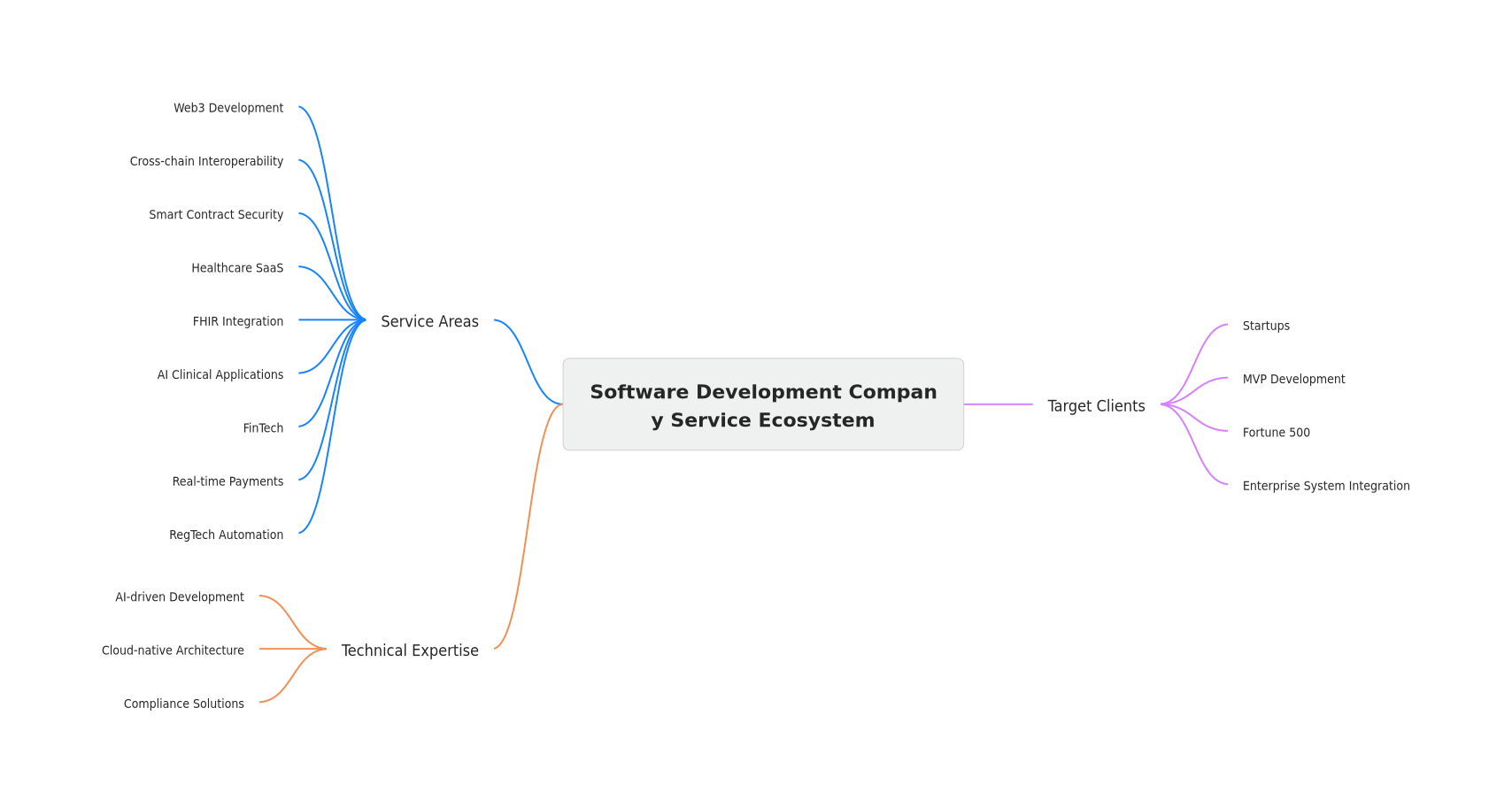
The competitive landscape for a software development company is increasingly defined by specialization in high-growth technical domains. Web3, Healthcare SaaS, and Fintech have emerged as the three primary battlegrounds, each characterized by distinct technical challenges, regulatory hurdles, and innovation drivers. Success in these sectors requires not only deep technical expertise but also a keen understanding of evolving standards and compliance requirements, as well as the ability to integrate emerging technologies like AI and blockchain into practical solutions.
2.1 Web3:跨链互操作与RWA代币化
In the Web3 space, a software development company’s ability to navigate cross-chain interoperability and real-world asset (RWA) tokenization has become a critical differentiator. The fragmented nature of blockchain ecosystems has led to a pressing need for standardized protocols that enable seamless communication and asset transfer between disparate networks. Chainlink’s Cross-Chain Interoperability Protocol (CCIP) has emerged as a leading solution in this regard, providing a secure and robust framework for cross-chain messaging and token transfers (Blockchain Interoperability Standards: Cross-Chain Web3 …). This protocol is increasingly being adopted by enterprises and financial institutions looking to leverage the benefits of blockchain technology without being tethered to a single network.
Platforms like Solana are pushing the boundaries of enterprise adoption by introducing developer-friendly APIs and tools that simplify the integration of blockchain functionality into existing systems (AI & Web3 Trends 2026: Coding Agents, Cybersecurity AI Race …). This has led to partnerships with major players like Mastercard and Western Union for stablecoin settlement and cross-border payments, demonstrating the growing practical applications of Web3 technologies.
Ethereum Layer 2 solutions, such as Arbitrum and Optimism, are addressing scalability concerns while maintaining compatibility with the Ethereum ecosystem, further expanding the possibilities for cross-chain applications (Smart Contracts Explained: 2026 Security Guide – BYDFi). These developments are not only technical but also regulatory, as seen with the introduction of the GENIUS Act in the U.S., which provides a framework for stablecoin regulation and sets standards for cross-chain financial operations (AI & Web3 Trends 2026: Coding Agents, Cybersecurity AI Race …).
The combination of these technological and regulatory advancements is significantly reshaping financial结算 and asset上链 processes. A forward-thinking software development company must stay abreast of these developments to offer cutting-edge solutions that bridge the gap between traditional finance and the emerging Web3 ecosystem.
2.2 医疗SaaS:FHIR与AI透明化
In the Healthcare SaaS sector, a software development company’s ability to comply with evolving interoperability standards and implement transparent AI solutions has become paramount. The Fast Healthcare Interoperability Resources (FHIR) standard, mandated by the CMS Interoperability and Prior Authorization Final Rule, has established itself as the cornerstone for healthcare data exchange (Healthcare Billing System Integration in 2026: HL7, API …). This standard, which combines the clinical data semantics of HL7 with modern RESTful API architecture, is not just a technical requirement but a strategic asset that enables healthcare organizations to transform data exchange into operational advantage (10 Healthcare Technology Predictions Shaping 2026).
Beyond interoperability, the HTI-1 Final Rule has introduced stringent transparency requirements for AI and machine learning algorithms used in clinical decision-making (10 Healthcare Technology Predictions Shaping 2026). This necessitates a software development company to implement robust AI governance frameworks, clear documentation standards, and clinician training programs to ensure algorithmic literacy. The ability to explain AI-driven insights and demonstrate compliance with these transparency requirements is quickly becoming a key competitive factor.
End-to-end encryption has also emerged as a non-negotiable requirement for Healthcare SaaS solutions, given the sensitivity of patient data. This, combined with the need for real-time data access and seamless integration with electronic health records (EHR), has raised the bar for entry into this market (7 Essential Features Every Healthcare SaaS Should Have in 2026).
A compelling example of these trends in action is the collaboration between Epic, a leading EHR provider, and CVS Health. This partnership leverages FHIR-based APIs to enable secure data exchange, supporting value-based care initiatives and improving patient outcomes through better care coordination (10 Healthcare Technology Predictions Shaping 2026). For a software development company, mastering these technologies and standards is essential to delivering solutions that not only meet regulatory compliance but also drive meaningful improvements in healthcare delivery.
2.3 金融科技:实时支付与RegTech自动化
The Fintech sector is undergoing a significant transformation driven by the adoption of real-time payment systems and the automation of regulatory compliance (RegTech). A software development company operating in this space must possess deep expertise in both cutting-edge payment technologies and sophisticated compliance automation tools.
The advent of FedNow in the United States and similar instant payment systems worldwide is revolutionizing the payment landscape, making real-time settlement an expected standard rather than a premium feature (Fintech trends for 2026 from AI orchestration to instant payments). This shift is being further accelerated by the adoption of ISO 20022, a global messaging standard that enhances data richness and interoperability across payment systems.
Parallel to these developments is the rise of AI orchestration in RegTech, enabling the automation of complex compliance workflows. AI-powered systems are now capable of handling everything from KYC/AML checks to transaction monitoring and regulatory reporting, significantly reducing manual effort and improving accuracy (How AI is reshaping compliance by design in 2026 – FinTech Global). These systems are not standalone solutions but integrated platforms that provide a unified view of an organization’s compliance obligations, replacing fragmented spreadsheets and manual processes.
Security remains paramount in this evolving landscape. The implementation of PCI-DSS v4.0 and zero trust architecture has become essential for protecting sensitive financial data, particularly in the context of Banking-as-a-Service (BaaS) and embedded finance solutions (Fintech Software Development 2026: Compliance & Security Guide). A software development company must demonstrate proficiency in implementing these security frameworks to gain the trust of financial institutions and their customers.
The convergence of these technologies is enabling new business models and operational efficiencies. For instance, AI orchestration is moving beyond isolated pilots to integrated systems that support end-to-end operations, from customer onboarding to fraud detection (Fintech Innovations To Watch In 2026 – Forbes). As these trends continue to evolve, a software development company’s ability to deliver secure, compliant, and real-time financial solutions will be critical to its success in the Fintech sector.
Understanding these technical specializations provides a foundation for evaluating the capabilities of different software development companies. The next section will compare leading firms based on their成立年份 and team规模, offering insights into how these factors influence their ability to deliver cutting-edge solutions in these dynamic domains.
三、Software development company标杆成立年份与团队规模
The majority of established software development companies have founding years clustered within the 2000-2010 timeframe, reflecting the industry’s substantial growth and maturation during that period. A notable trend in recent years is the bipolarization of team sizes driven by advancements in AI tools. These tools have enabled smaller teams to accomplish tasks that previously required larger groups, while complex enterprise projects continue to demand extensive human resources, creating a divergence in optimal team configurations.
3.1 小型敏捷团队:2-5人MVP模式
The advent of AI code assistants has revolutionized the minimum viable product (MVP) development landscape, significantly reducing the team size required to bring a product to market. According to Andresmax’s 2026 research, AI tools have enabled a 60% reduction in the size of MVP teams (Are Large Software Teams Still Relevant in the Age of AI?). This dramatic shift is underpinned by the substantial productivity gains AI offers across various development tasks: writing boilerplate code (5-10x faster), debugging (2-4x faster), learning new frameworks (3-5x faster), writing documentation (2-4x faster), and creating tests (3x faster).
A prominent example of this trend is the collaboration between Replit and Microsoft. By integrating Microsoft’s advanced AI models into Replit’s development environment, the platform empowers individual developers and small teams to build, test, and deploy applications with unprecedented efficiency. This partnership exemplifies how AI is not merely augmenting existing workflows but fundamentally redefining the possibilities for small, agile development teams.
The optimal MVP team size in 2026 typically ranges from 2 to 5 people, often consisting of 1-2 full-stack engineers, a designer with coding capabilities, and potentially a part-time product manager (Are Large Software Teams Still Relevant in the Age of AI?). This lean structure fosters rapid decision-making, easier pivoting, and closer customer proximity, all crucial advantages in the early stages of product development.
3.2 中型项目团队:8-15人近岸交付
For medium-scale projects that require more specialization than an MVP but are not yet enterprise-level in complexity, nearshore delivery models with teams of 8-15 professionals have emerged as a highly effective solution. Companies like nCube exemplify this approach, such as their work in组建 an Eastern European development team for Flightright. This model leverages significant cost advantages (often 40-60% lower than Western European rates) while maintaining favorable timezone alignment, reducing communication delays and facilitating real-time collaboration.
The productivity benefits of such teams are quantifiable through DORA (DevOps Research and Assessment) metrics, which are industry-standard for measuring software development performance. Teams with clearly defined roles and responsibilities, as is typical in well-structured nearshore setups, are 50% more productive according to DORA metrics (What is the Optimal Size of a Development Team? – Smartexe). A balanced medium-sized team might include a Tech Lead, 4-6 Developers (front-end, back-end, and full-stack), 2 QA Engineers (with automation expertise), 1-2 Designers, and a DevOps Engineer. This configuration ensures agility while providing the necessary depth to handle more complex challenges, such as API development, mobile app creation, and scaled testing.
Nearshore teams also benefit from cultural alignment and geographical proximity compared to offshore alternatives, further enhancing collaboration and reducing the likelihood of misunderstandings. This makes them particularly well-suited for scaling FinTech platforms, launching mobile applications, and other projects where a balance of cost, expertise, and communication efficiency is critical.
3.3 企业级团队:20-50+人复杂系统
Enterprise-level software development, characterized by complex multi-platform products, large-scale systems, and stringent regulatory requirements, necessitates significantly larger teams, typically ranging from 20 to 50+ professionals. Two exemplary firms in this space, despite differing scales, are ScienceSoft and EPAM Systems, each bringing distinct strengths to enterprise projects.
ScienceSoft, founded in 1989, employs a global team of over 750 IT professionals (Top 10 Software Development Companies in 2026 – ScienceSoft). With 35+ years of experience and 4,000+ completed projects across 30+ industries, ScienceSoft specializes in complex digital transformation and AI-driven modernization, particularly in heavily regulated sectors like healthcare, banking, manufacturing, and retail. Their strength lies in deep architecture expertise (20+ certified architects across AWS, Azure, TOGAF, and IASA CITA) and mature project management, ensuring robust governance and adherence to strict compliance requirements.
In contrast, EPAM Systems, founded in 1993, boasts a massive global workforce of over 40,000 professionals (Top 12 Custom Software Development Companies in 2026). EPAM is renowned for its “Engineering DNA” and structured delivery approach, excelling in cloud platform development, AI/ML integration, and enterprise architecture for large Fortune 500 clients. Their global presence allows them to tackle the most extensive and geographically dispersed projects, offering scalability and a breadth of resources that few can match.
Both companies prioritize security and compliance, but their approaches reflect their scale. ScienceSoft, with its more concentrated size, might offer more tailored attention to specific regulatory nuances, while EPAM’s vast resources allow it to deploy specialized compliance teams across multiple jurisdictions simultaneously. The choice between such vendors often hinges on the specific needs of the enterprise, balancing the depth of expertise, scale of resources, and the ability to navigate complex, multi-faceted security and architectural challenges inherent in large-scale systems.
Understanding the correlation between company founding years, team size philosophies, and their ability to execute different project types provides valuable context for evaluating potential software development partners. The following section will delve into real-world client success cases, illustrating how these factors translate into tangible business outcomes when partnering with a software development company.





